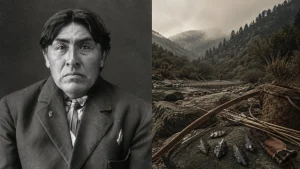
The 13,900-Year-Old Mastodon Rib Found With A Bone Point Still Inside — And The CT Scan That Put Hunters Before Clovis
The Bone Inside The Bone
There is a mastodon rib in a laboratory.
It is large, as ribs go — the rib of an animal that stood roughly ten feet tall and weighed several tons — and it is old in a way that makes most human timescales feel trivial.
The bone is dark with age, mineralized over millennia, and it carries within it a piece of evidence that took nearly forty years of argument, three waves of increasingly sophisticated technology, and the collaboration of radiocarbon laboratories, CT scanners, biomolecular analysts, and 3D reconstruction specialists to fully understand.
Embedded in that rib — driven into it from the outside, penetrating the bone and stopping partway through — are fragments of another bone entirely.
Not part of the same skeleton.
Not a fracture.
A foreign object, made from a different animal, that struck the rib and did not pass through, leaving its shattered tip locked inside the tissue of an animal that was already dying or already dead.
The embedded fragments date to approximately 13,800 to 13,900 calibrated years before the present.
That means the event they record — whatever happened to this mastodon, on what is now the Olympic Peninsula of Washington State — occurred before the end of the last Ice Age.
Before the great continental glaciers had fully retreated.
Before sea levels had risen to anything close to their modern positions.
Before most of the ecosystems that define the Pacific Northwest today had come into existence.
And crucially — before what was, for most of the twentieth century, considered the oldest confirmed human occupation of the Americas.
The mastodon rib from the Manis site in Washington State is one of the most contested, most studied, and ultimately most significant pieces of physical evidence in the ongoing effort to understand when people first arrived in the Western Hemisphere and how they lived.
The foreign bone embedded in it is not a stone spear point.
It is not an arrowhead.
It is a fragment — several fragments, actually, reconstructed through modern digital methods — of a projectile tip made from mastodon bone itself: an osseous weapon, deliberately shaped, driven hard enough into a living or recently dead animal to break off inside the rib.