The Three Oak Trees
Chapter 1 — The Chapel
When I called my parents from the hospital chapel, my hands were still streaked with ash from the accident scene.
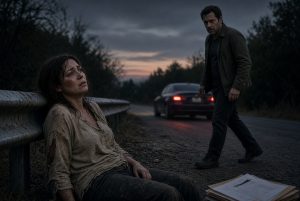
That morning, my husband, Jonathan Albright, had been driving our two children along Route 66 near Flagstaff, Arizona.
Samuel was seven years old.
Charlotte was four.
A long-haul driver, exhausted, had drifted across the center divider, and there had been no time for Jonathan to react.
All three of them died at the scene.
I will not describe it beyond that, because the details belong to them and to no one else, and because there is nothing to be gained by laying out the worst morning of my life for anyone to look at.
It is enough to say that in the span of a few seconds, on an ordinary road on an ordinary morning, with no warning and no reason and no chance to say goodbye, my entire family was taken from me.
I survived only because I had stayed home that morning to finish a work project.
That is the whole of the reason I am alive: a deadline, a desk, a decision to catch up on email instead of riding along.
For a long time afterward, the fact of it sat on my chest like a stone I could not lift — that I was breathing, that my heart was still beating, solely because I had chosen, on that particular morning, to stay behind.
There is a specific and terrible weight to surviving the people you were supposed to grow old beside, and I carried it into that chapel, and I have carried it, in one form or another, ever since.
But that morning, in the chapel, with ash still on my hands, I was not yet thinking about any of that.
I was only trying to do the one thing a person does in the first hour of an unbearable loss: I was trying to call my family, so that I would not have to be alone with it.
I would struggle, in the months that followed, with the accident of my own survival, and I want to name it honestly, because survivor’s guilt is a specific and vicious form of grief that few people understand who have not felt it.
There is a part of the bereaved mind that cannot accept the sheer arbitrariness of it — that Jonathan and the children rode along and died, and I stayed home and lived, for no reason grander than a work deadline.
The mind rebels against that randomness.