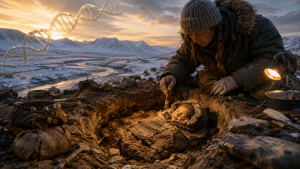
Shanidar Z — The 75,000-Year-Old Neanderthal Woman Whose Crushed Skull Was Rebuilt From More Than 200 Pieces
The result is a complete digital model of the excavation in its original state: a record that preserves spatial information even after the physical context has been disturbed by the excavation itself.
This three-dimensional documentation is not just for record-keeping.
It allows researchers to analyze spatial relationships between finds after the excavation is complete — to ask, for example, whether bones are clustered in ways that suggest deliberate arrangement, or whether the distribution of pollen samples corresponds to specific areas within the burial context.
Micro-stratigraphic analysis — the study of sediment at millimeter-scale resolution — allows researchers to distinguish between layers that formed through different processes: natural accumulation, human disturbance, animal burrowing, or flooding.
Each type of sediment formation leaves a characteristic signature in the grain size, mineralogy, and organic content of the layer.