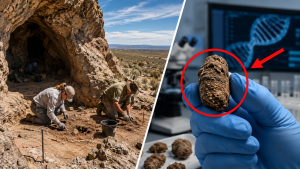
She Has Been Dead For 45,000 Years. In 2026, Three Different Scientists Gave Her Three Different Faces — And Each One Revealed Something The Others Missed
And certain dense bone tissues — particularly the petrous bone, the hardest bone in the human body, located inside the skull behind the ear — create a physical barrier that can protect DNA from environmental degradation for tens of thousands of years.
Paleogeneticists have learned to exploit this differential preservation.
By targeting the petrous bone — drilling into its dense matrix and extracting the minuscule quantity of DNA that may have survived there — researchers can sometimes recover ancient genomes in conditions where no other bone in the body has preserved any usable genetic material.
When they do recover an ancient genome, what they can learn from it is extraordinary.
The genome of an ancient human — extracted with extraordinary care, sequenced across millions of base pairs, and compared against both modern human populations and other ancient genomes — is essentially a compressed record of population history.