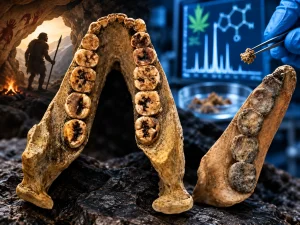
The 10,000-Year-Old Man Found In A British Cave — And The DNA Test That Changed What Scientists Thought Early Europeans Looked Like
The paper found that the petrous bone consistently yielded orders of magnitude more endogenous (authentic ancient) DNA than other skeletal elements, and that this advantage held across specimens from different environmental conditions and different ages.
Before this discovery, ancient DNA researchers often used teeth or the compact bone of limb shafts as their primary samples.
The identification of the petrous bone as far superior transformed the field: it made it possible to obtain whole genomes from specimens that would previously have yielded only limited genetic information.
For the Cheddar Man analysis, this was critical.
The researchers drilled into the petrous portion of Cheddar Man’s temporal bone, extracting just a few milligrams of bone powder — a minimally destructive sample — that contained enough DNA to support whole-genome sequencing.
The cave environment contributed additional preservation: the cool, stable temperature and the mineral-rich limestone environment that characterizes Gough’s Cave had helped prevent the degradation of the biological material over ten thousand years.