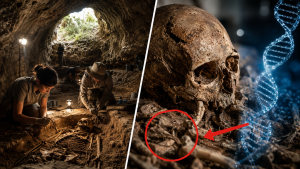
The 10,300-Year-Old Man Found Inside An Alaskan Island Cave — And The DNA Test That Revealed 10,000 Years Of Native Coastal Continuity
The genomic analysis found that Shuká Káa showed genetic affinity to the later Indigenous peoples of the Northwest Coast — that his ancestry was closely related to the ancestors of the Tlingit, the Haida, and the other coastal nations of the region.
This finding addressed the continuity question directly.
Rather than being genetically divergent from later coastal peoples — which would have suggested a population replacement — Shuká Káa was genetically related to them in ways consistent with ancestry.
His genome and the genomes of later Northwest Coast peoples were part of the same genealogical tree.
The implication — that the Northwest Coast peoples represent a deep, continuous ancestry on the coast, extending back approximately 10,000 years to the post-glacial founding of the coastal population — is among the most significant findings from the Shuká Káa analysis.
It transformed the question from an open one to a substantially answered one: the Indigenous peoples of the Northwest Coast are not late arrivals to a coast that was previously occupied by unrelated people.