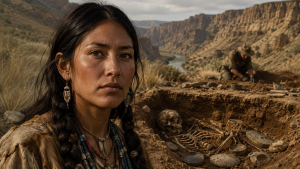
The 10,300-Year-Old Man Found Inside An Alaskan Island Cave — And The DNA Test That Revealed 10,000 Years Of Native Coastal Continuity
The genetic diversity of the founding Native American population and its distribution across the hemisphere is consistent with, though not exclusively explained by, a coastal dispersal scenario.
Some genetic models suggest an early differentiation of coastal and interior populations that would be consistent with separate dispersal routes — one along the coast and one through the interior.
Shuká Káa does not by himself prove the coastal route.
He is one individual at one location at one time period, and his presence on Prince of Wales Island 10,300 years ago tells us directly about that time and place rather than about the events of thousands of years earlier when the first people were entering the Americas.
But the deep genetic continuity between Shuká Káa and later Northwest Coast peoples suggests that the coastal population of the Northwest Coast was founded and established early — that the people who became the Northwest Coast nations did not arrive late and settle a coast that was already occupied by unrelated people, but were themselves the founding population of this specific coastal region.