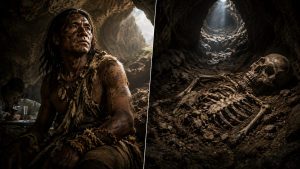
The 10,600-Year-Old Man Found In Nevada — And The DNA Discovery That Changed The Story Of The First Americans
Their construction — the materials, the sewing technique, the specific form of their manufacture — would become one of the important sources of information about who this person was and what cultural tradition he belonged to.
And the body itself, partially preserved in a way that was extraordinary for its age, retained hair and tissue that would later yield one of the most important ancient DNA samples ever extracted in the study of the first Americans.
None of this was apparent when the Wheelers made their assessment in 1940.
The technology to fully exploit what the cave had preserved did not yet exist.
The techniques for radiocarbon dating — the method that would eventually reveal the burial’s true age — were still being developed.