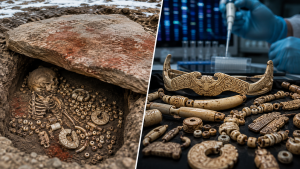
The 11,500-Year-Old Baby Found In Alaska — And The DNA That Revealed A Lost Branch Of The First Americans
This was not a non-Native founding group.
It was not a separate migration from outside the Native American founding lineage.
It was a branch of the same founding population — genetically Native American in the full relevant sense — that had maintained its distinct character for thousands of years before being gradually absorbed by or replaced by populations that expanded into the Alaskan interior from the south.
The finding was revolutionary for two reasons.
First, it demonstrated that the founding population of the Americas was more diverse than previously appreciated — that the internal structure of the founding population included at least two major branches that diverged before the main southward expansion, rather than being a single, undifferentiated group that then rapidly diversified as it spread south.