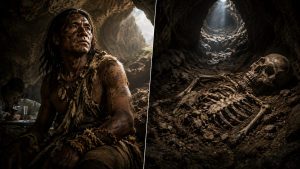
The 13,000-Year-Old Clovis Child Found With Ancient Weapons — And The Burial That Changed America’s First People Story
The very young age of the child, and the impossibility that a child of one to three years could have personally accumulated the artifacts buried with it, points strongly toward ascribed rather than achieved status.
The child was buried with objects that represented the group’s wealth and the group’s social position, not the child’s own personal accomplishments.
This has implications for how we think about Clovis social organization more broadly.
Clovis society was not simply a collection of independent nuclear families roaming the landscape.
It was a social system with at least some degree of internal differentiation, with family or lineage groups that had higher and lower status, and with mortuary practices that expressed and reinforced that differentiation.
The Anzick burial provides the most direct evidence for this social complexity in the entire Clovis archaeological record.