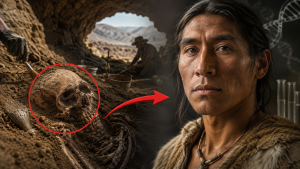
The 13,000-Year-Old Man Found On A California Island — And The Dating Test That Changed The Story Of America’s First Migration
This means that a specific carbon-14 age, expressed in radiocarbon years before present, does not correspond directly to a specific calendar age.
The conversion from radiocarbon years to calendar years requires a calibration curve: a table or graph that accounts for atmospheric carbon-14 variation over time, built from samples of known age — tree rings being the most important — whose carbon-14 content can be measured directly.
The calibration curves available in 1962 were primitive compared to what exists today.
The conversion from radiocarbon years to calendar years could not be done with the precision that later science would achieve.
A date expressed as “approximately 10,000 radiocarbon years BP” translated to a calendar age with substantial uncertainty.