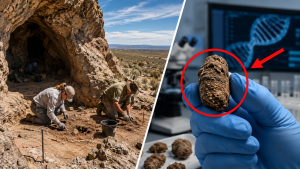
The 13,000-Year-Old Man Found On A California Island — And The Dating Test That Changed The Story Of America’s First Migration
It was while examining the canyon walls for mammalian fossils — the bones of the pygmy mammoths — that Orr saw something in the sediment that was distinctly not a mammoth.
Two femoral fragments.
Human.
Eroding from a layer that, by every indication he could read in the stratigraphy of that canyon wall, dated to the end of the Pleistocene.
Orr recognized what he had immediately.
He also recognized the problem.
Radiocarbon dating — the technique that had given archaeologists their first reliable clock for measuring the age of ancient organic material — was still a young science in 1959.
It had been developed by Willard Libby in the late 1940s, and the methods available in 1959 were not capable of producing the precise age determination that fragmentary ancient bone required.