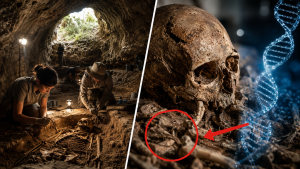
The 13,000-Year-Old Man Found On A California Island — And The Dating Test That Changed The Story Of America’s First Migration
Charcoal is well-suited for radiocarbon dating; it concentrates carbon in a chemically stable form that resists contamination reasonably well.
But charcoal from the same layer as the bones is not the same as a date from the bones themselves, and the relationship between the charcoal and the human remains — whether they were truly deposited at the same moment — required geological interpretation.
Orr’s interpretation, based on his reading of the stratigraphy, was that the bones and the charcoal were contemporaneous.
The bones had come from the same water-laid sediments that contained the dated charcoal, from a depth that placed them at the end of the Pleistocene.