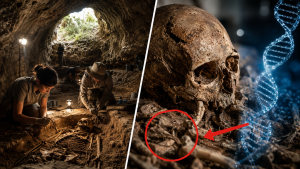
The 14,200-Year-Old Human DNA Found In Ancient Feces — And The Oregon Cave Discovery That Challenged Clovis
The documentation included both standard archaeological recording methods — measured profile drawings, detailed written descriptions of each sediment layer — and micromorphological sampling, in which blocks of undisturbed sediment were removed intact, hardened with resin, sectioned into thin slices, and examined under microscopes in a laboratory.
Micromorphology allows archaeologists to see the detailed structure of sediment at a scale that is invisible to the naked eye — the arrangement of particles, the presence of biological remains, the chemical stains that indicate past processes — and to characterize the specific events that formed each layer.
The radiocarbon dating program was dramatically expanded.
The 2008 paper had relied on a relatively small number of radiocarbon dates to establish the age of the pre-Clovis layers.
The 2012 program added many more dates, from a wider range of materials distributed throughout the sediment sequence.