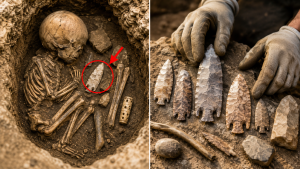
The 23,000-Year-Old Footprints Found In New Mexico – And The Evidence That Rewrote America’s Human Timeline
Aquatic plants are known to be susceptible to what is called the reservoir effect — a phenomenon in which organisms that live in or draw carbon from lake or river water can incorporate carbon that is older than the organism itself.
Here is why that matters.
Radiocarbon dating works by measuring the ratio of radioactive carbon-14 to stable carbon-12 in an organic sample.
Living organisms incorporate carbon from the atmosphere (or, for aquatic organisms, from the water) continuously throughout their lives.
When an organism dies, it stops incorporating new carbon, and the carbon-14 it contains begins to decay at a known rate.
By measuring how much carbon-14 remains, laboratories can calculate how long ago the organism died.