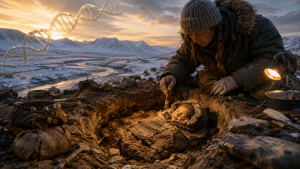
The 24,000-Year-Old Boy Buried With 120 Beads And A Mammoth-Ivory Tiara — And The DNA Test That Revealed A Hidden Source Of Native American Ancestry
In most environments, DNA is essentially destroyed within a few thousand years.
The warm, moist conditions of most burial environments accelerate this degradation.
In cold, dry environments — the permafrost of the Arctic, the interior of cold, dry caves, the sealed soils of Siberia — DNA degradation is substantially slowed.
Cold reduces bacterial activity.
Low humidity reduces the water-mediated chemical reactions that attack DNA bonds.
The result, in favorable cases, is the preservation of fragmentary but readable DNA in remains that are tens of thousands of years old.
The field of ancient DNA research grew from a small beginning in the 1980s into a scientific revolution in the 2000s and 2010s, driven primarily by the development of next-generation sequencing: a technology that can read millions of short DNA fragments simultaneously, rather than requiring the long, intact DNA chains that older sequencing methods demanded.