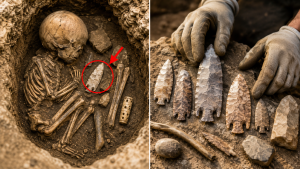
The 4,500-Year-Old Egyptian Man Found In A Tomb — And The DNA Test That Revealed His Unexpected Ancestry
It pointed east.
To Mesopotamia.
To the ancient river valleys of what is now Iraq, the cradle of the world’s earliest urban civilizations, more than a thousand miles from the banks of the Nile.
This was not a man who looked merely inward, toward the Nile valley that built him.
His genes carried a record of connections that reached across deserts and across the ancient world.
And extracting that record from a tooth in a Liverpool museum was one of the most technically demanding and most historically significant things that science has done in recent years.
This is the story of how it happened, what it means, and why it changes — and does not change — what we know about one of humanity’s greatest civilizations.
Why Ancient Egyptian DNA Is So Hard To Get
The story of ancient DNA from Egypt is, until 2025, largely a story of failure.
It is not that researchers did not try.
The history of attempts to extract DNA from Egyptian mummies goes back to the very earliest days of ancient DNA research — before the field had properly established itself, before the methods for authenticating ancient sequences existed, before the technology of next-generation sequencing made it possible to read the short, broken fragments that survive in ancient remains.
Svante Pääbo, the Swedish geneticist who would go on to win the Nobel Prize in Physiology or Medicine in 2022 for his work sequencing the first Neanderthal genome, was among the first to attempt the extraction of DNA from Egyptian mummies.
He was a doctoral student when he tried, in the 1980s, and his early work appeared to show results — but later analysis, using more rigorous authentication methods, demonstrated that the sequences he recovered were almost certainly contamination from modern human DNA that had crept into the samples during handling and analysis.
This problem of contamination is one of the two fundamental obstacles to ancient DNA work in Egypt.