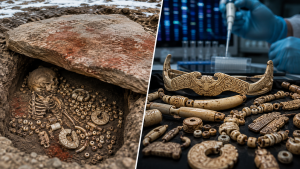
The 6,000-Year-Old People Found Near Bogotá — And The DNA Test That Revealed A Native American Lineage That Vanished From The Genetic Record
This points toward some degree of sedentism or repeated seasonal return to a fixed location, rather than purely mobile nomadic existence.
However, the nature and permanence of this occupation remains a subject of archaeological interpretation.
The broader archaeological context of Checua is the Preceramic period of the Bogotá Altiplano — roughly 11,500 to 4,000 years before the present — a long span during which the population of the plateau was hunter-gatherers who had not adopted the pottery-making and formal agriculture that would come later.
This period saw multiple environmental changes, including the retreat of the Ice Age climates that had characterized the region during the terminal Pleistocene, the evolution of the Altiplano’s vegetation from open grassland toward more closed forest and wetland environments, and the gradual intensification of human land use as populations stabilized.