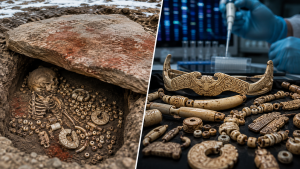
The 6,000-Year-Old People Found Near Bogotá — And The DNA Test That Revealed A Native American Lineage That Vanished From The Genetic Record
One important finding from other South American ancient DNA studies has been the identification of what some researchers call a “Population Y” or “Australasian-related” signal in some early South American genomes — a genetic component that appears to connect some early South Americans to populations from Southeast Asia or Australia, suggesting either a distinct founding migration or a more complex pre-Beringian ancestry than the simple North America-to-South America model assumes.
The Colombia study did not detect this signal in the Checua individuals, though the limited coverage and specific comparison populations used mean that this absence should be interpreted cautiously.
Other ancient South American genomes — including some from early Amazonian sites and from the southern cone — show high levels of affinity to the “southern Native American” lineage associated with Anzick-1 and the Clovis-related founding population.
The Checua individuals’ lack of affinity to this lineage suggests that they represent a distinct trajectory within the early South American radiation — one that diverged from the common ancestor of other South Americans before the southern Native American ancestry pattern became established.