The 8,000-Year-Old Cemetery Found Beneath A Florida Pond — And The Human Brain Tissue Still Preserved Inside The Skulls
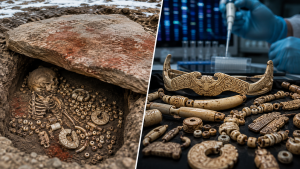
The woven textile fragments — displayed under the conditions required to prevent further deterioration — make real the abstract claim that 8,000-year-old fabric survived in a Florida pond.
The bone and antler tools are tangible evidence of a technological tradition that the standard archaeological record does not preserve.
The personal ornaments — the shell and seed necklaces — connect the scientific narrative to the individual lives behind it.
The exhibit, and the broader public presence of Windover in Florida historical consciousness, represents the site’s second life after the excavations.
The artifacts and remains are no longer in the pond; they exist now as a scientific and educational archive, maintained by institutions whose responsibility is to preserve them for future generations of researchers and visitors.
This archival role is not without its own ethical complexity.