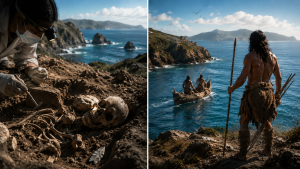
The 8,800-Year-Old Man Found 1,000 Feet Inside A Colorado Cave — And The DNA Test That Linked Him To A Native American Founder Lineage
What it does establish — clearly, significantly, and without overstatement — is that this man was Native American in the deepest biological sense: a member of the founding population of the Americas, carrying a maternal lineage that connects him to the same ancient roots from which all Indigenous peoples of this hemisphere descend.
What Haplogroup B’s Distribution Tells Us
The geographic distribution of haplogroup B among modern Native American populations is itself informative about the population history of the Americas, and placing the Hourglass Cave man in haplogroup B connects him to a story that extends far beyond a single cave in Colorado.
Haplogroup B shows a distinctive distribution in the Americas.
It is present in both North and South America, but its frequency varies considerably across regions and populations.
It is particularly common in some Indigenous populations of Central America and western South America — the Pacific slope of the Andes, the Yucatan Peninsula, and adjacent regions.