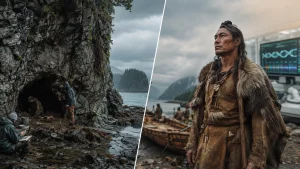
The 9,000-Year-Old Child’s Tooth Found In An Alaska Cave — And The DNA Test That Revealed A Lost Population Of The First Americans
Within the broadly defined ancestral Native American population, the earliest differentiation that has been documented in the ancient-genome record is between the Ancient Beringians and the populations that gave rise to all other Native Americans.
This differentiation appears to have occurred within Beringia — before the dispersal of people southward through the Americas — and represents the earliest detectable branching event in the genealogy of the founding Native American population.
On the genomic level, what “Ancient Beringian” means is that USR1 and the Trail Creek child show a specific pattern of genetic ancestry that places them as outgroups to the rest of the Native American phylogenetic tree — they share more ancestry with the root of the tree than with any specific later Native American population branch.
This position in the phylogenetic tree is what the label “Ancient Beringian” is designed to capture.