What We Kept
Chapter 1 — The Key Under the Frog
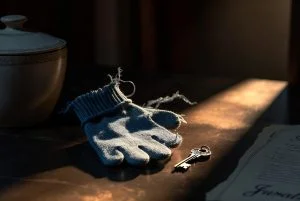
The spare key was still under the concrete frog by the back step, where it had been my entire childhood, and I stood in the cold with it in my hand for a long time before I could make myself use it.
It felt like breaking into a house that had already forgotten me.
My mother had died on a Tuesday, in her sleep, at eighty-one, in the front bedroom of the house on Sycamore Street where she had lived for fifty-three years and where I had not set foot in nine.
The funeral had been small and I had flown in for it and flown out the same night, and I had told myself that was enough, that I had done the thing a daughter does.
But there was a house to empty and sell, and there was no one to empty it but the two of us, and so here I was three weeks later on a gray November afternoon, letting myself in the back door with a key I was somehow still not surprised to find.
Terry’s truck was in the driveway.
I had seen it from the street and sat in my rental car for ten minutes working up to it, because the truth was that I was not afraid of the empty house.
I was afraid of my brother, who was inside it, and whom I had not been in a room with in nine years.
Nine years is a strange length of estrangement.
It is long enough that the original wound scars over and you forget the exact shape of it, and short enough that the person is still entirely themselves in your memory, unaged, frozen at the moment you stopped.
In my mind Terry was still thirty-nine, still the brother who had stood across our father’s grave from me, and I knew that the man in that kitchen would not be that man, that he would be gray now and thicker through the middle and marked by years I hadn’t witnessed, and that the not-witnessing was itself the crime I’d committed against him.
We had not fought, exactly.
That is the thing people misunderstand about estrangement; they imagine a blowup, a slammed door, a line in the sand.
Ours had been quieter and worse than that — a slow letting-go, a not-calling that became a habit that became a fact, a silence that neither of us had ever formally declared and so neither of us knew how to formally end.
There had been no moment I could point to and say, there, that is where I lost my brother.
There had only been a hundred small choices not to reach, on both sides, until the reaching would have required an explanation neither of us was willing to give.
And now our mother had died and made the explanation unavoidable, because you cannot empty a house through a wall of silence, and so I got out of the car.