
CHAOS ON THE RUNWAY: DEADLY LaGuardia CRASH SPARKS MAJOR SAFETY FEARS
At first, the sequence of events didn’t seem to align. The timing felt impossibly tight, the commands appeared to overlap, and the margin for error was almost nonexistent. To seasoned aviation analysts, the early fragments of communication raised immediate concern. Something wasn’t right.
What initially looked like a tragic accident quickly began to resemble something more troubling—a potential breakdown within a system designed to prevent exactly this kind of disaster.
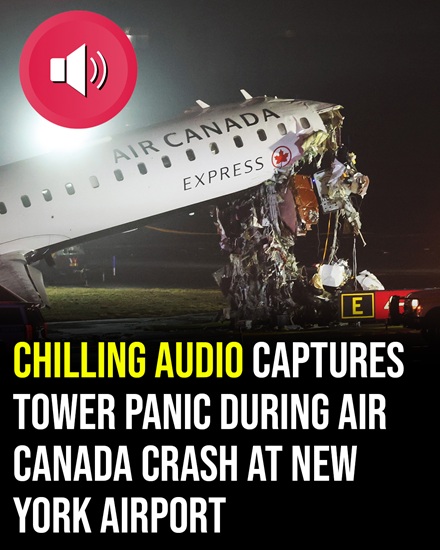
And what unfolded on that rain-slick runway at LaGuardia Airport would soon leave experts, officials, and the public searching for answers.
Late in the evening on March 22, a devastating aviation incident sent shockwaves across the industry. Air Canada Express Flight 8646, a Bombardier CRJ-900 operated by Jazz Aviation, was nearing the end of a routine flight from Montréal. Onboard were 72 passengers and four crew members, expecting an uneventful arrival.
The approach into LaGuardia appeared standard. Despite nighttime conditions and wet weather, the aircraft aligned correctly with Runway 4. There were no immediate signs of trouble. Everything pointed to a normal landing.
But within moments of touchdown, the situation took a catastrophic turn.
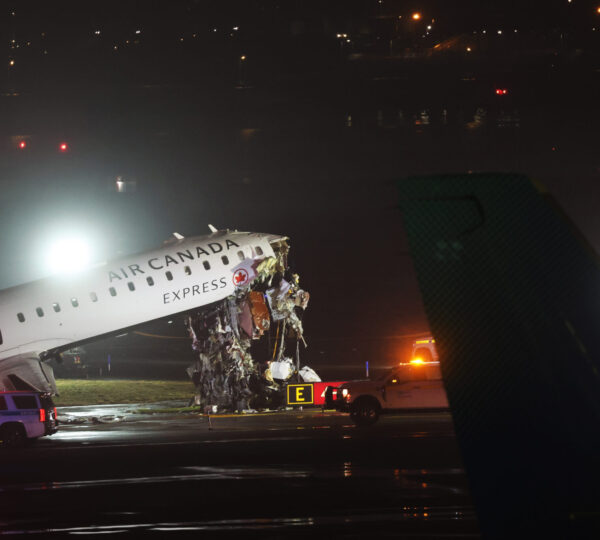
As the aircraft’s wheels met the runway and deceleration began, a Port Authority fire-rescue truck entered the same active runway—directly into the jet’s path. The vehicle had reportedly been cleared to cross, responding to a separate situation elsewhere on the airfield.
The collision that followed was sudden, violent, and devastating.
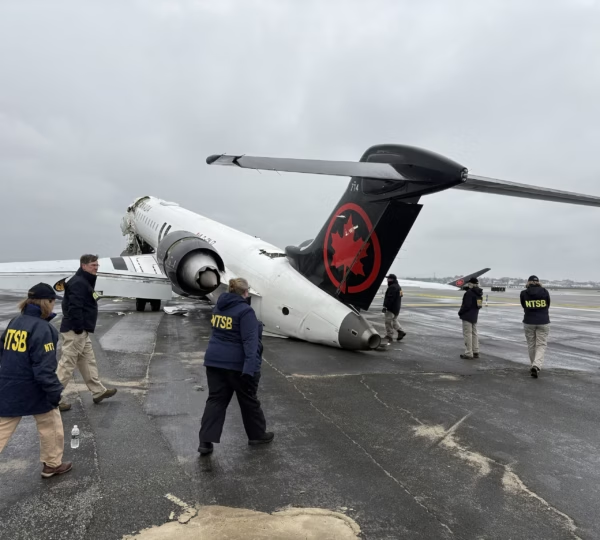
The truck tore into the forward section of the aircraft, inflicting catastrophic damage on the cockpit. Both pilots were killed in the impact, a loss that has deeply shaken the aviation community.
Inside the cabin, chaos erupted. Passengers were jolted violently as the aircraft shuddered to a halt. Overhead bins burst open, and the interior was thrown into confusion and fear. In total, 39 people sustained injuries, several of them serious.
Emergency responders rushed to the scene within minutes, pulling survivors from the damaged aircraft and transporting the injured to nearby hospitals. The two individuals inside the fire-rescue vehicle were also hospitalized, though their conditions have not been fully disclosed.
Almost immediately, LaGuardia Airport was brought to a standstill. A full ground stop was issued, halting all arrivals and departures as emergency teams worked to secure the runway, assess damage, and prevent further خطر.
Federal agencies moved quickly. Investigators from the National Transportation Safety Board (NTSB) and the Federal Aviation Administration (FAA) arrived to begin piecing together what had gone wrong.
At the center of the investigation lies a critical and deeply concerning question: how were two separate entities—an arriving passenger jet and an emergency vehicle—both cleared to occupy the same runway at nearly the same time?
Early evidence suggests a breakdown in communication or coordination, possibly involving overlapping clearances issued within a dangerously narrow window.
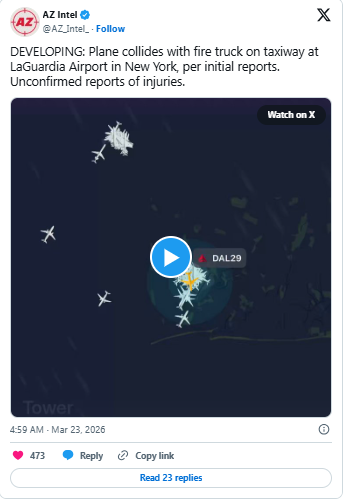
Air traffic control recordings have provided a haunting glimpse into the final seconds before impact. In the audio, a controller can be heard urgently trying to stop the fire truck, repeating the command: “Stop, stop, stop… Truck 1, stop!”
The urgency in the voice is unmistakable.
But the warning came too late.
Following the collision, controllers acted quickly to contain the situation. Other aircraft in the vicinity were rerouted, and incoming flights were diverted to alternate airports. These rapid decisions likely prevented an already catastrophic event from escalating further.
Investigators are now examining multiple contributing factors. Among them are the operational pressures of managing traffic at one of the busiest airports in the United States, the added urgency of an emergency vehicle responding to another aircraft, and the challenging weather conditions at the time.
Rain and reduced visibility may have complicated both visual awareness and communication clarity. While modern aviation systems are built to handle such conditions, they can still increase complexity and reduce reaction time.
The impact of the collision extended far beyond the runway.
More than 600 flights were delayed or canceled, sending ripple effects throughout the regional air travel network. Nearby airports, including JFK and Newark, were forced to absorb diverted flights, creating additional congestion and logistical challenges.
Passengers stranded at LaGuardia described scenes of confusion and frustration. Long lines formed at service counters, and departure boards quickly filled with cancellations. Airport staff worked continuously to manage the disruption, but the scale of the incident made recovery difficult.
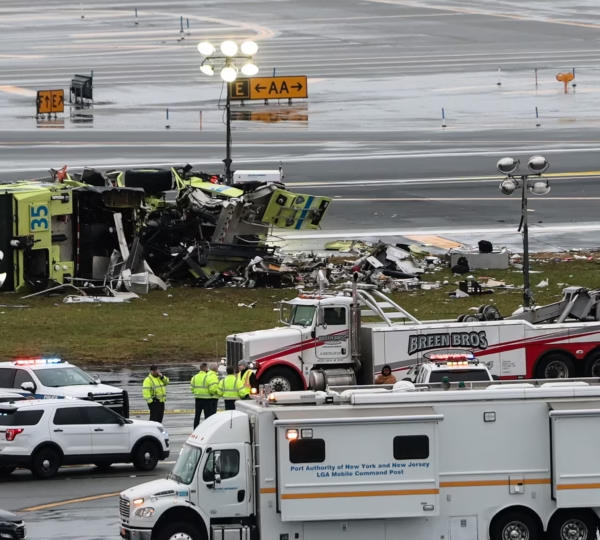
Overnight, crews worked to clear debris, inspect runway integrity, and restore limited operations. Full functionality, however, took significantly longer to return.
From a broader perspective, the incident has reignited concerns about runway incursions—rare but potentially catastrophic events involving conflicting use of active runways.
Aviation experts point to several systemic challenges, including increasing air traffic volumes, controller workload, and the growing complexity of airport ground operations. In high-pressure environments like LaGuardia, even a small lapse can have severe consequences.
There are also renewed calls for enhanced technological safeguards. Some experts argue that more advanced automated systems could help detect and prevent conflicting clearances in real time, adding an additional layer of protection.
Preliminary flight data indicates that Flight 8646 was operating normally during its approach and landing, suggesting that the aircraft itself was not a contributing factor. This has shifted focus more heavily onto ground coordination and communication procedures.
Air Canada and Jazz Aviation have issued statements expressing condolences to the families of the deceased pilots and support for those affected. Assistance programs have been set up for passengers and crew.
Meanwhile, the Port Authority has pledged full cooperation with investigators, as the search for answers continues.
Survivor accounts paint a vivid picture of the moments after impact—fear, confusion, and then urgency. Yet many also highlighted the professionalism of the crew, whose actions helped ensure a rapid evacuation and likely prevented further loss of life.
As the investigation moves forward, officials emphasize that no final conclusions have yet been reached. Data from flight recorders, radar systems, and communication logs will be carefully analyzed to reconstruct the sequence of events.
Conclusion
The LaGuardia runway collision stands as a sobering reminder of how fragile the balance between efficiency and safety can be in modern aviation. In a system built on precision, timing, and coordination, even the smallest breakdown can lead to devastating consequences. As investigators work to uncover the full story, the focus remains not only on what went wrong, but on how to ensure it never happens again.
The lessons drawn from this tragedy are expected to influence future safety protocols, technological advancements, and operational procedures across the industry. For now, the world watches closely—hoping that from this loss will come meaningful change and a renewed commitment to safer skies.