
It started as just another joke on the internet — a viral image, a few sarcastic replies, and thousands of people laughing along.
But beneath the memes and mockery, something more uncomfortable was hiding in plain sight. What looked like harmless online humor had actually cracked open a conversation many men have spent years avoiding.
Behind the jokes about “ideal bodies” and “peak performance” was a truth few were willing to say out loud: a growing number of men are quietly at war with the way they look.
A meme can often tell us more about society than a serious debate ever could. Sometimes what begins as a joke reveals a truth people have been trying to ignore. That is exactly what happened when the “ideal male body” meme started spreading across the internet.
On the surface, it looked like just another wave of online humor — random images, exaggerated physiques, and sarcastic captions mocking the idea of what men are “supposed” to look like. But underneath the jokes was something much deeper: an uncomfortable reminder that men, too, are deeply insecure about their bodies.
For years, body image conversations have largely centered around women, and for understandable reasons. Women have long been subjected to unrealistic beauty standards, heavily edited magazine covers, impossible fashion ideals, and relentless social pressure to look a certain way.
But what often gets overlooked is that men are also living under a growing mountain of appearance-based expectations. Their insecurities may be less openly discussed, less validated, and often hidden behind humor, but they are no less real.
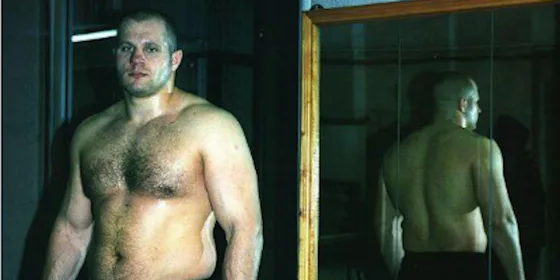
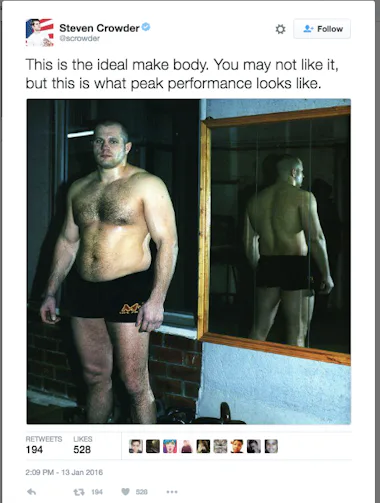
The viral meme in question gained traction after conservative commentator and podcaster Steven Crowder posted a tweet featuring Russian MMA legend Fedor Emelianenko standing casually in fighting shorts near a set of kettlebells.
Crowder declared that this physique represented the “ideal male body,” accidentally typing “make” instead of “male” — a typo that only fueled the internet’s amusement. Though the original post had been sitting online for months, social media eventually revived it, and once it did, the floodgates opened.
People began responding with absurd, hilarious, and wildly exaggerated alternatives to what they considered the “ideal make body.” Images of everything from fantasy creatures to oddly proportioned celebrities started circulating. Some responses were intentionally ridiculous, others subtly brilliant.
On the surface, it was internet comedy at its best: quick, strange, and ruthlessly funny. But the reason it resonated so strongly wasn’t just because it was amusing. It struck a nerve because it touched on something many men recognize but rarely admit — the pressure to fit into a narrow, confusing, and often contradictory standard of masculinity.
Men are told they should be strong, but not vain. Lean, but not obsessed. Muscular, but not trying too hard. Rugged, but still attractive. Effortless, but somehow perfect. It is a bizarre balancing act, and one that many men feel they are failing without ever saying so.
The “ideal male body” meme worked because it exposed how ridiculous the whole concept is. Yet even while mocking the idea, it reminded people that the expectation still exists.
The truth is that male body insecurity is not some niche issue affecting only a few image-conscious men. It is far more widespread than many people realize. Research from the Central YMCA and the Succeed Foundation has suggested that men may be even more insecure about their appearance than most assume — and in some areas, possibly even more than women. While that should never become a competition, it does challenge the stereotype that men are somehow less affected by beauty standards.
According to the findings, many men’s biggest insecurities revolve around issues such as beer bellies, “man boobs,” lack of muscle definition, and thinning hair. These concerns may sound casual when thrown around in jokes or locker-room banter, but they cut deeply.
Around 30 percent of men reported hearing negative comments about their “beer belly,” while 19 percent had been called “chubby,” and another 19 percent said they had overheard people making remarks about their chest or body shape. These are not insignificant numbers. They represent millions of men who are carrying shame, embarrassment, and self-consciousness about their appearance.
And it doesn’t stop with weight. For many men, being too skinny can feel just as humiliating as being overweight. While women have often been pushed toward unrealistic thinness, men are bombarded with the opposite ideal: they are expected to be broad-shouldered, visibly muscular, toned, and physically dominant.
The media’s version of the desirable man is often some genetically blessed hybrid of superhero, athlete, and fitness model — someone whose body is not just healthy, but sculpted to perfection.
As a result, many ordinary men feel like they are falling short simply by existing in a normal human body. The same research found that 63 percent of men did not believe they were muscular enough to be considered attractive. Think about that for a moment.
Nearly two-thirds of men felt they lacked the physical build required to be seen as desirable. That is not just insecurity — that is a culture-wide confidence problem.
Perhaps even more telling is how much value many men place on physical perfection. In one striking statistic, 38 percent of men said they would give up an entire year of their life in exchange for what they considered a “perfect body.” It is a startling figure because it reveals just how emotionally powerful body dissatisfaction can be. It is not just about wanting abs or bigger arms. It is about self-worth, desirability, confidence, and the fear of not measuring up.
Still, the goal here is not to argue that men “have it worse” than women. That misses the point entirely. Body insecurity is not a contest. Pain does not become more valid by proving someone else hurts less. What matters is recognizing that insecurity exists across the board, and that many men are struggling in silence simply because they have been taught not to talk about it.
This silence becomes even more obvious in the world of online dating, where appearance is often the first and most heavily judged factor. A study from the University of North Texas highlighted an important shift in how body image and self-esteem affect men in the digital dating age.
Researchers found that male Tinder users, in particular, showed significantly lower self-esteem compared to non-users.

That finding is especially important because online dating is often framed as something that primarily harms women — whether through harassment, objectification, or inappropriate behavior. And while those problems are very real, the emotional impact on men deserves attention too. Apps like Tinder can be brutal environments for self-worth, especially for men, because they create a constant, visible cycle of judgment and rejection.
Men are statistically more likely to swipe right more often, exposing themselves to far more potential rejection. Many receive fewer matches, less engagement, and less validation than they expected.
Over time, that can take a serious toll. When someone repeatedly puts themselves forward and gets ignored, dismissed, or ghosted, it becomes easy to internalize the idea that they are not attractive enough, desirable enough, or simply not enough.
This matters because body image is rarely just about the mirror. It is often tied to acceptance. To belonging. To romantic success. T
o confidence in social spaces. A man may not look at himself and think, “I wish I had a six-pack,” in isolation. More often, the thought is connected to something deeper: “Maybe I’d be wanted if I looked different.” That is where body insecurity becomes especially painful.

And then there is the media machine, which quietly reinforces all of this every single day. Movies, advertisements, social media, sports culture, and even wellness industries all contribute to a modern male ideal that is nearly impossible to sustain. Men are shown bodies that are not just fit, but optimized.
Bodies that are often achieved through extreme dieting, dehydration before shoots, personal chefs, trainers, favorable lighting, strategic posing, and sometimes even enhancement drugs. Yet those realities are rarely visible. What people see is the polished final product — and they compare their ordinary bodies to it.
The result is a constant state of dissatisfaction. Someone is always leaner. Someone else is always taller, more defined, broader, younger, more “masculine.” There is always another standard to chase. And because the ideal keeps shifting, no one ever really arrives. The finish line keeps moving.
What makes all of this more frustrating is that men are often expected to laugh it off. A woman expressing body insecurity may be met with empathy, support, or at least understanding. A man doing the same is often met with jokes, dismissal, or awkward silence. He is told to “just go to the gym,” “man up,” or stop being dramatic. That response doesn’t make the insecurity disappear. It only buries it deeper.
This is why memes like the “ideal male body” trend matter more than they seem to. Humor often creates space for truths people are too uncomfortable to say directly. The internet laughed because it recognized the absurdity of trying to define one “ideal” male body. But in doing so, it also exposed how much emotional baggage men carry around appearance. The joke landed because the insecurity behind it was already there.
And maybe that is where the conversation needs to shift. Instead of debating what men “should” look like, perhaps the better question is why so many feel they need to meet a visual standard at all in order to feel worthy. Why are so many men tying their confidence to body fat percentages, jawlines, shoulder width, or hairlines? Why is normal aging treated like failure? Why is softness, average-ness, or imperfection seen as something to fix rather than something human?
None of this means health should be dismissed. Wanting to feel strong, energetic, and physically well is not the problem. The issue is when health gets replaced by aesthetic obsession, and when worth becomes tangled up in appearance. A man should be allowed to care about his body without being consumed by shame. He should be able to pursue fitness without believing his value depends on looking like an action figure.
At the end of the day, most people are not walking around with celebrity-level physiques, and that is perfectly fine. Real life is not a fitness shoot. Real bodies are shaped by stress, genetics, work schedules, aging, family responsibilities, finances, and yes — by enjoying things like burgers, wings, fries, and lazy weekends. Human bodies are not branding projects. They are meant to be lived in.
Maybe that is why the “ideal male body” meme was so unexpectedly revealing. It reminded us that beneath all the filters, flexing, and posturing, many men are still quietly wondering if they are enough. And perhaps the healthiest response is not to laugh at that insecurity, but to recognize it for what it is: a deeply human fear shared by far more people than we like to admit.
Conclusion
The “ideal male body” meme may have started as internet comedy, but it ended up exposing something much more serious: men are struggling with body image too, and many of them are doing it in silence. Behind the jokes, sarcastic replies, and viral posts is a very real issue rooted in unrealistic expectations, social pressure, and self-worth. Instead of treating body insecurity as a gendered problem, we should recognize it as a human one. No one benefits from impossible standards, and no one should feel ashamed for not looking like a curated fantasy. The real goal should not be perfection — it should be confidence, balance, health, and the freedom to exist in your body without constantly feeling like it needs to be fixed.