
Trump Administration Suspends $10 Billion in Federal Funding to Five States, Sparking Political and Humanitarian Concerns
The announcement came without warning, but its impact was immediate. Governors, agency officials, and families relying on social welfare programs were left scrambling as a familiar source of support suddenly vanished.
While the administration framed the move as a necessary safeguard, critics quickly questioned its timing, scope, and targets. What appeared at first to be a routine bureaucratic action has quickly become a major flashpoint in the ongoing debate over federal authority, state autonomy, and social safety nets.
The Funding Freeze

In a decision that has sent ripples through Washington and state capitals alike, the Trump administration announced it will suspend more than $10 billion in federal funding for five Democratic-led states: California, Colorado, Illinois, Minnesota, and New York.
The freeze affects major programs including:
Temporary Assistance for Needy Families (TANF): Provides cash support, housing, job training, and education for low-income families, especially single-parent households.
Child Care Development Fund (CCDF): Supports affordable child care, enabling parents to work or pursue education.
Social Services Block Grant (SSBG): Funds a range of community services, including foster care, adult protective services, and mental health programs.
According to the Department of Health and Human Services (HHS), the action is intended to prevent fraud and ensure federal funds are used appropriately. HHS spokesperson Andrew Nixon stated, “Democrat-led states and governors have allowed significant levels of fraud to occur. The Trump administration is committed to protecting taxpayer dollars and ensuring federal funds are used for legitimate purposes.”
Scope and Implications
The financial impact of the suspension is extensive:
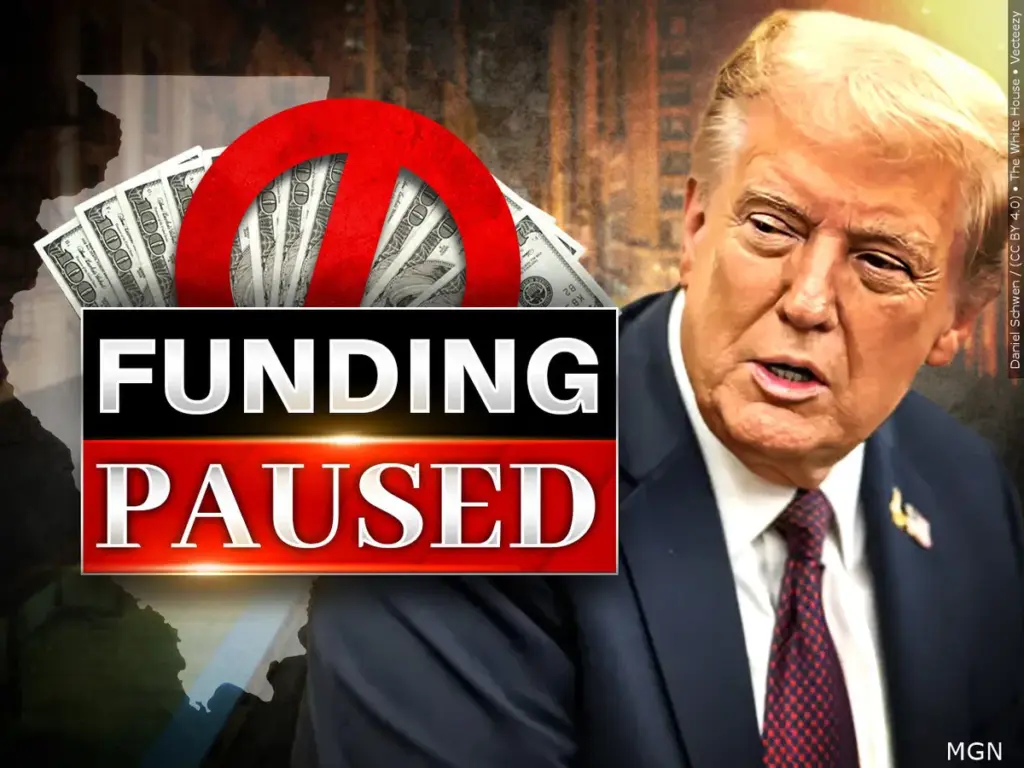
TANF: Over $7.3 billion withheld.
CCDF: $2.4 billion withheld.
SSBG: $869 million withheld.
The freeze threatens assistance for millions who rely on these programs for child care, housing, food security, and other essential services.
In letters to state governors, HHS Assistant Secretary Alex Adams cited federal prosecutions and allegations of misused funds. While specific cases were not detailed, the administration maintains the freeze is a precautionary step to protect program integrity.
Political and State Responses
Democratic leaders immediately condemned the decision as political retaliation.
Senator Kirsten Gillibrand (NY): Called the move “immoral and indefensible,” accusing the administration of targeting children and low-income families for political gain.
Governor Gavin Newsom (CA): Condemned it as a direct assault on vulnerable families.
Governor J.B. Pritzker (IL): Warned it would harm children, seniors, and working parents.
Governor Tim Walz (MN): Cautioned about devastating consequences for those already facing economic hardship.
Governor Jared Polis (CO): Argued that sweeping allegations lack substantiated evidence.
Legal analysts suggest the freeze could face federal court challenges as states explore judicial remedies.
Human and Economic Consequences
Experts warn the freeze could have serious consequences:
TANF cuts may delay benefits, increasing poverty risk in high-cost urban areas.
CCDF cuts could force parents to reduce work hours or leave jobs, affecting household income and child development.
SSBG cuts may reduce services for seniors, foster children, domestic violence survivors, and individuals with disabilities, increasing strain on community organizations.
Nonprofit groups and child advocacy organizations caution that reduced access to licensed child care may push families toward unsafe alternatives and negatively affect children’s health and well-being.
Oversight, Context, and Legal Considerations
While the administration cites fraud concerns, past audits generally show low rates of misuse relative to total spending. A 2022 federal audit found only isolated issues, and experts note that blanket freezes are rare; targeted audits are the usual approach to address mismanagement.
Legal experts also note that courts often scrutinize actions disproportionately affecting low-income populations and may require concrete evidence to justify withheld funds.
Broader Federal-State Implications
The freeze raises fundamental questions about federal authority, state autonomy, and cooperative federalism. Critics argue that using funding suspensions as political leverage risks setting a dangerous precedent. Economists warn that reduced social service funding could ripple through local economies, lowering workforce participation and increasing reliance on emergency assistance programs.
Conclusion
The suspension of more than $10 billion in federal funding has ignited a national debate over accountability, political power, and the human cost of policy decisions. While the Trump administration maintains the freeze is necessary to combat fraud, critics argue it places undue burden on vulnerable families and risks long-term damage to essential support systems.
As governors consider legal challenges and advocacy groups mobilize, millions of Americans face uncertainty. The coming weeks will determine whether the freeze is lifted, modified, or overturned—but its impact has already reshaped discussions around federal oversight, state responsibility, and the real-world consequences of political decisions that extend far beyond Washington.