
What initially looked like a technical dispute over administrative guidance has evolved into a significant legal battle that could redefine how federal agencies interpret and enforce eligibility rules for one of the nation’s largest assistance programs.
As legal experts examined the filing, deeper questions emerged—about statutory authority, timing, and whether executive agencies exceeded the limits set by Congress.
A coalition of 21 states, along with the District of Columbia, has filed a lawsuit against the U.S. Department of Agriculture (USDA), challenging new restrictions on immigrant eligibility for the Supplemental Nutrition Assistance Program (SNAP). The lawsuit was filed on Nov. 26 in the U.S. District Court for the District of Oregon.
At the center of the dispute are provisions of the One Big Beautiful Bill (OBBB) Act, signed into law by President Donald Trump, which altered long-standing SNAP eligibility rules for certain immigrant groups.
Prior to the OBBB, some lawfully present immigrants were eligible for SNAP benefits after meeting program requirements and completing a five-year waiting period, unless exempt under the Personal Responsibility and Work Opportunity Act (PRWORA), according to an Oct. 31 USDA statement.
Following the law’s enactment, the USDA issued guidance stating that some immigrant groups previously eligible for SNAP were no longer eligible under the new framework. The guidance outlines five categories that remain eligible for benefits: U.S. citizens, U.S. nationals, Cuban and Haitian entrants, citizens of Compact of Free Association nations, and lawful permanent residents (LPRs), commonly known as green card holders.
The lawsuit focuses heavily on how the USDA interprets eligibility for lawful permanent residents. While immigrants may enter the U.S. under various classifications, many later adjust their status to become LPRs. The states argue that the USDA’s guidance unlawfully narrows eligibility for individuals who are legally authorized to reside permanently in the United States.

According to the guidance itself, some immigrant groups—such as certain American Indians born abroad, members of Hmong or Highland Laotian tribes, battered immigrants, conditional entrants, and victims of severe human trafficking—may qualify for SNAP once they obtain LPR status. However, other groups are explicitly categorized as “not eligible,” including refugees, asylum recipients, parolees, individuals whose deportation has been withheld, and certain Afghan and Ukrainian parolees.
The states contend this distinction violates federal law. They argue that individuals in both categories who adjust to lawful permanent residency should be treated equally under SNAP rules. Refugees and asylum recipients, for example, are statutorily eligible to apply for LPR status after one year in the U.S.
“The Guidance specifically categorizes many individuals as ‘Not eligible’ despite having clear statutory pathways to becoming lawful permanent residents,” the states wrote in their filing.
The lawsuit further challenges the USDA’s interpretation that refugees, asylum seekers, and other humanitarian immigrants are subject to a five-year waiting period for SNAP benefits. The states argue that PRWORA explicitly exempts these groups from the waiting period and that the OBBB did not amend those exemptions.
Beyond eligibility, the lawsuit also disputes new SNAP payment error provisions introduced by the OBBB. Previously, SNAP benefits were fully federally funded. Under the new law, states must contribute funds if their payment error rates exceed certain thresholds—starting at 5% of benefit costs for error rates between 6% and 8%, and rising to 15% for error rates of 10% or more.
Federal regulations allow a 120-day exclusionary period following new rules, during which errors are not counted toward payment error calculations. The USDA’s Oct. 31 guidance stated that this exclusionary period ended on Nov. 1, calculated from the date the OBBB became effective. The states strongly disagree, arguing that the exclusionary period should begin no earlier than Oct. 31, 2025—the date the guidance was issued—and last 120 days from that point.
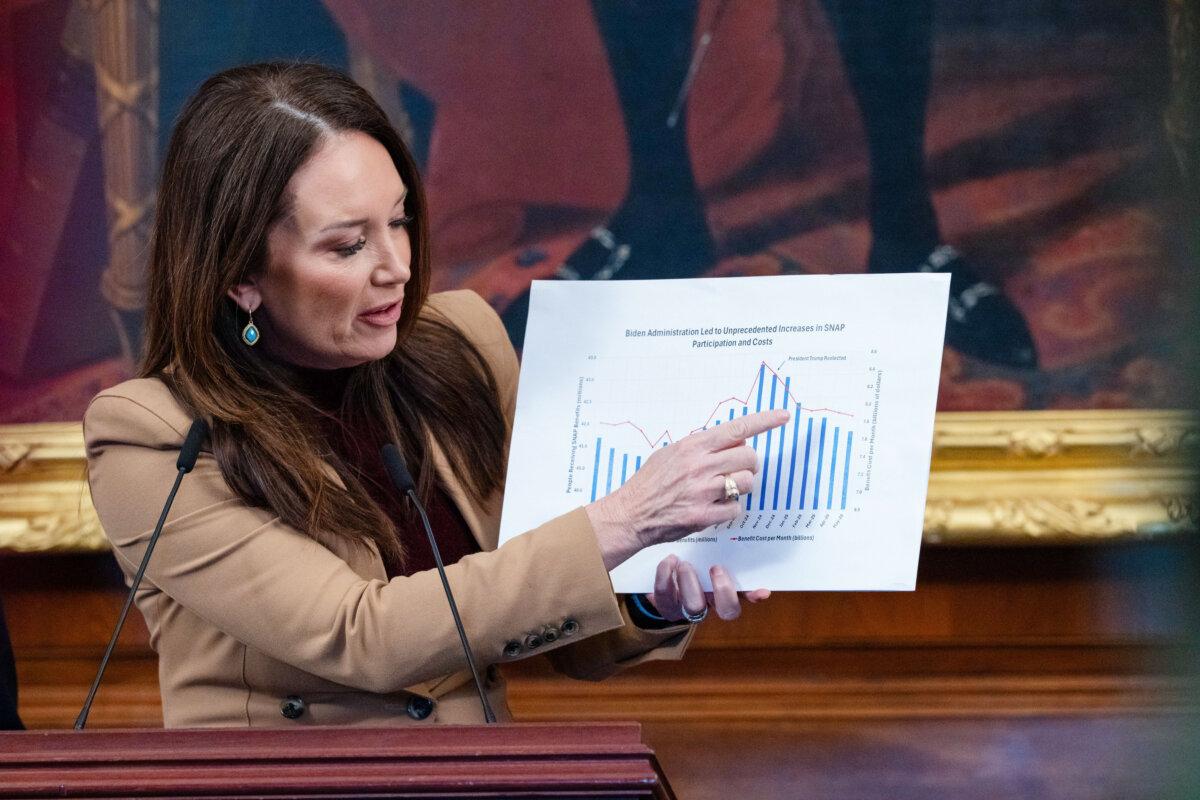
The lawsuit also references broader enforcement efforts. In an April 24 memorandum, the USDA instructed states to strengthen verification procedures to prevent illegal immigrants from receiving SNAP benefits. These measures include verifying identities, collecting Social Security numbers, cross-checking death records, and reviewing Department of Homeland Security databases.
The directive followed a Feb. 19 executive order from President Trump requiring agencies to tighten eligibility verification for taxpayer-funded benefits.
In public interviews, Agriculture Secretary Brooke Rollins said USDA audits uncovered SNAP payments issued to nearly 186,000 deceased individuals and identified approximately 500,000 cases of duplicate payments. Rollins characterized the lawsuit as an effort by mostly Democrat-led states to block federal access to SNAP data.
According to USDA figures, approximately 42 million Americans currently receive SNAP benefits, with an average monthly payment of $177 per person. The USDA has not yet publicly responded to the lawsuit.
Conclusion
The legal challenge underscores growing tensions between state governments and federal agencies over immigration policy, welfare administration, and executive authority.
As courts determine whether the USDA’s guidance aligns with congressional intent, the outcome could have far-reaching consequences for immigrant families, state budgets, and the future enforcement of SNAP eligibility rules. For now, the case highlights how deeply intertwined—and contested—immigration and public benefits policy have become in the national debate.