
In Port-au-Prince, power is rarely visible—it moves quietly through alliances, accusations, and influence.
As violence tightens its grip on the capital and international pressure intensifies, recent U.S. sanctions have sparked deeper questions. Are these actions purely about dismantling gang networks, or do they reflect political fault lines within Haiti’s fragile leadership during a critical transitional period?
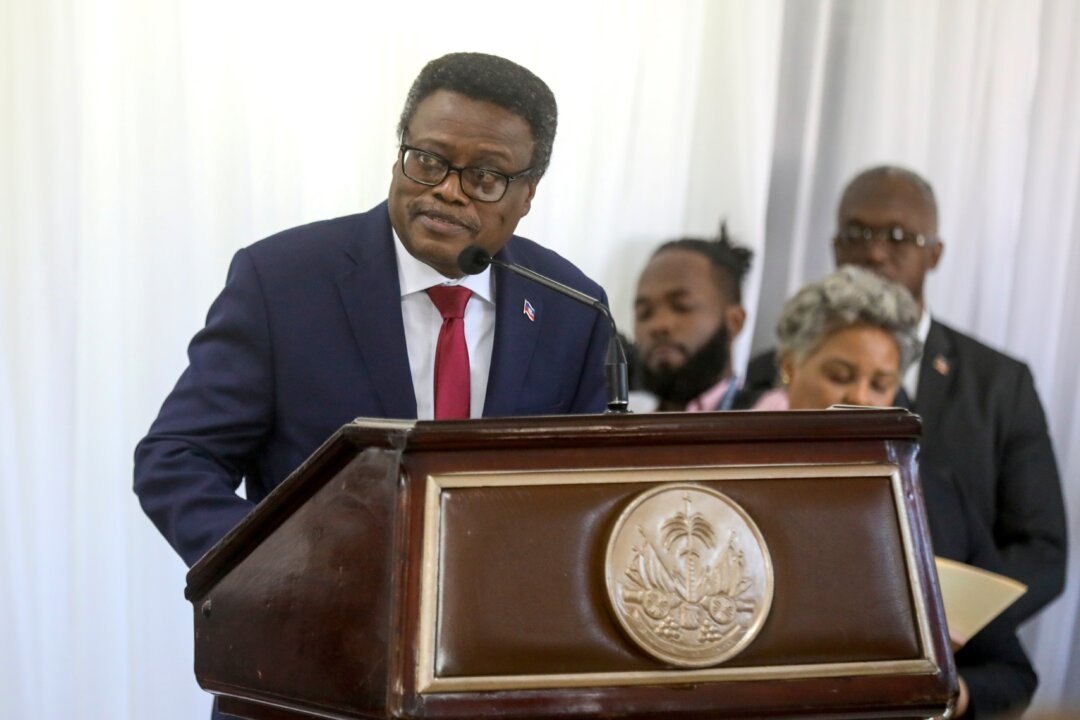
On November 24, the U.S. State Department announced new visa restrictions against a senior Haitian official accused of collaborating with armed gangs and undermining efforts to confront what Washington classifies as terrorist-linked criminal organizations. The decision was made under U.S. immigration law, which authorizes entry bans on individuals whose conduct is deemed harmful to American foreign policy interests.
The sanctions fall within a broader policy introduced in October 2022, aimed at targeting individuals—and their immediate family members—who provide financial or logistical support to Haiti’s criminal networks. In addition to restricting future travel, any existing U.S. visas held by the sanctioned individual have been revoked.
In a statement accompanying the announcement, the State Department emphasized its stance: “The Haitian people have suffered long enough from unchecked gang violence, institutional paralysis, and political instability. The United States will continue to hold accountable those who obstruct Haiti’s path toward democratic governance and regional security.”
A day later, Fritz Alphonse Jean, a member of Haiti’s transitional presidential council, confirmed to the Associated Press that he was the official named in the sanctions.
The council was formed in 2024 following the resignation of former Prime Minister Ariel Henry, after gang-related violence dismantled the country’s governing structure.
Jean strongly rejected the allegations, claiming that members of the transitional council have faced sustained pressure from international partners. He stated that threats of visa cancellations and sanctions had been communicated by both the U.S. Embassy and Canadian representatives. The Canadian Embassy did not issue a response prior to publication.
Haiti is expected to hold national elections by February 7, at which point the nine-member transitional council is scheduled to step down. Jean maintained that the council remains committed to confronting corruption, dismantling state capture, and targeting networks involved in drug trafficking, arms smuggling, and illicit financing.
The country’s crisis deepened following the 2021 assassination of President Jovenel Moïse, triggering a prolonged collapse of political authority and public security. The United Nations estimates that over 1.4 million Haitians have been displaced internally. Carlos Ruiz Massieu, head of the U.N. mission in Haiti, has described the human rights situation as alarming, citing abuses carried out by gangs, vigilante groups, and, at times, security forces themselves.
International security efforts have struggled to gain traction. A Kenya-led multinational mission approved by the U.N. Security Council in October 2023 faced funding shortages and operational limitations, allowing gangs to maintain control over large sections of Port-au-Prince. In September, the mission was replaced by the multinational Gang Suppression Force (GSF)—a 5,550-member unit established under a Security Council resolution co-sponsored by the United States and Panama.
The GSF has been granted a 12-month mandate to dismantle gang strongholds, protect critical infrastructure, and facilitate humanitarian access. U.S. Secretary of State Marco Rubio stated that the force would evolve into a broader burden-sharing framework with adequate resources, declaring that “the era of impunity for those destabilizing Haiti has come to an end.”
U.S. Embassy Alert
On the same day the sanctions were announced, the U.S. Embassy in Port-au-Prince issued a security alert highlighting the rapid deterioration of conditions in the capital. Sunrise Airlines, one of Haiti’s few regional carriers, suspended operations after one of its aircraft was struck by gunfire. Major highways linking Port-au-Prince to surrounding regions have become increasingly dangerous, frequently controlled or disrupted by armed groups.
The embassy reiterated its highest-level travel warning, advising U.S. citizens to avoid Haiti entirely. Those still in the country were urged to shelter in place and prepare for shortages of food, fuel, and water, as well as disruptions at ports and airports. Earlier this month, U.S. Marines assigned to embassy security briefly exchanged fire with suspected gang members.
United Nations data shows that more than 5,600 people were killed in Haiti in 2024 alone, with violence spreading beyond the capital into areas previously considered stable. Armed groups are now estimated to control nearly 90 percent of Port-au-Prince.
In response, the United States pledged an additional $60 million in humanitarian and security assistance in July, raising total U.S. support for Haiti in 2025 to $165 million, according to U.S. Ambassador to the U.N. Linda Thomas-Greenfield.
Conclusion
The visa sanctions mark a sharper turn in U.S. engagement with Haiti, signaling a willingness to directly challenge individuals within the country’s transitional leadership. While American officials frame the action as a necessary step against gang influence and political obstruction, critics warn it may further complicate an already fragile transition. With elections approaching, armed groups entrenched, and international forces racing against time, Haiti stands at a crossroads—where justice, sovereignty, and stability are increasingly difficult to separate.