
When the attorney slid a tiny brass key across the table, attached to a card with an address I didn’t recognize, a cold ripple traveled down my spine.
My father had been a man of routines, quiet habits, and predictable decisions. A hidden address didn’t fit into any version of him I thought I knew. Something about it felt unsettling—like I was about to uncover a chapter of his life that he had deliberately kept closed.
My father passed away earlier this year. His estate was simple, almost minimal—no surprises, no debts, nothing unusual. The will read exactly as we expected, until the lawyer paused, brow furrowing.
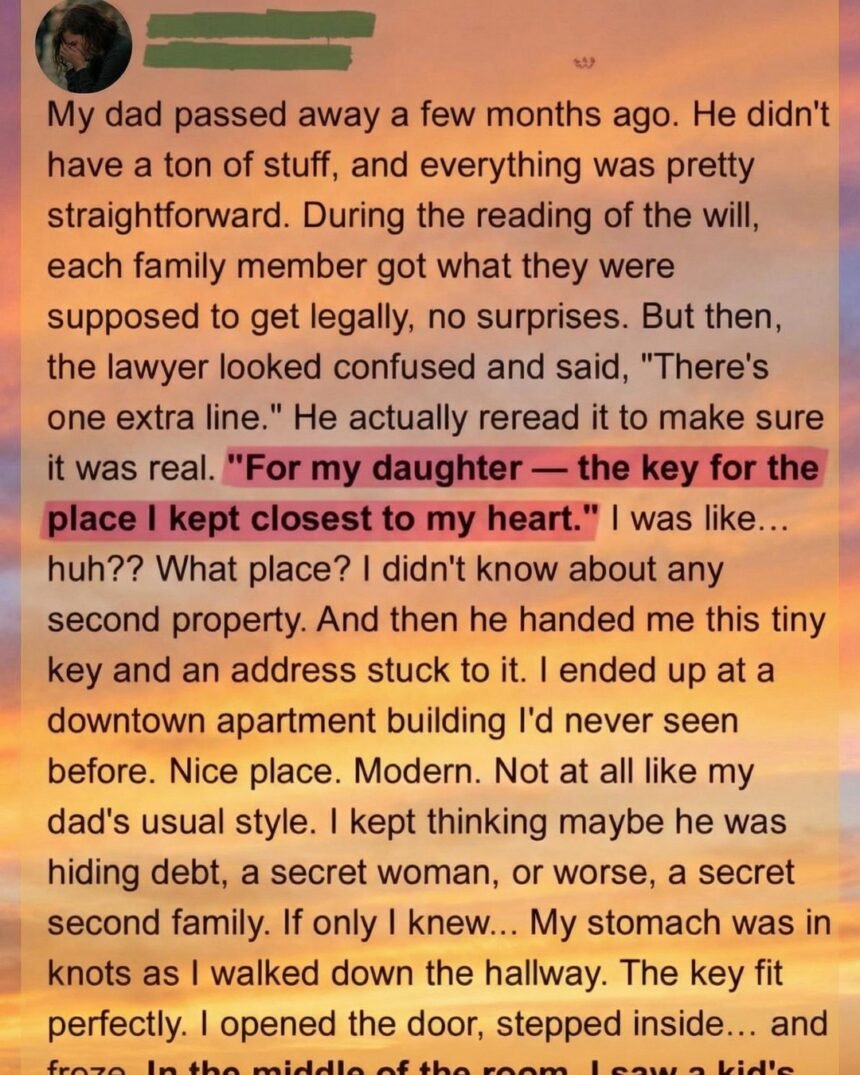
“There’s one last item,” he said softly. “For my daughter: the key to the place I kept closest to my heart.”
The words hit me strangely. A place? Closest to his heart? My father wasn’t a man who spoke in riddles. Yet here I was, staring at a key that felt heavier than its weight.
When I arrived at the address—a sleek apartment building downtown, far from the quiet neighborhood where he had lived—I braced myself. My imagination churned through uncomfortable possibilities: a lover he’d never spoken of, financial trouble, maybe even a life he’d led entirely apart from us.
The key turned smoothly in the lock.
The moment the door opened, my breath caught.
The first thing I saw was a framed drawing on the wall—a childish sketch of a house, a stick-figure man, and a little girl with two lopsided pigtails. Mine. A drawing I’d made when I was five. A drawing I’d forgotten.
The whole apartment was arranged like a private archive of my childhood. Shelves lined with sun-faded Polaroids. A jar filled with seashells from our first beach trip. My scuffed kindergarten backpack, carefully cleaned and displayed on a hook. A mug I had painted for him in second grade, the colors chipped but still bright.
This wasn’t a secret life.
It was a memorial to a life we’d shared.
On a small desk near the window sat a stack of notebooks in his familiar handwriting. My hands trembled as I opened them. They weren’t diaries—more like letters he had written but never sent. Apologies for moments he regretted. Notes about my achievements. Reflections about how proud he was, even on days he didn’t know how to say it aloud.
One line felt like it cracked me open:
“She’s grown now, but this place keeps me close to the days she held my hand. I hope someday she’ll understand I always needed her more than she needed me.”
In that quiet apartment, surrounded by pieces of my own forgotten childhood, I finally understood the meaning of the key. My father hadn’t hidden a secret life—he had created a private refuge for his most cherished memories. A place where he could revisit the years when I was small, when life felt simpler, when love was expressed through bedtime stories and beach trips and tiny backpacks.
When I finally stepped out and locked the door behind me, I didn’t feel the dread I’d arrived with. I felt… held. As though my father had left me a final reminder that even the smallest moments had mattered to him. That despite his silence, his love had always been steady, quiet, and deeply rooted.
He didn’t leave me a burden.
He left me a doorway back to him.
Conclusion
Love doesn’t always speak in grand gestures or eloquent words. Sometimes it lives in the quiet corners—kept in drawings, mementos, and memories we didn’t know someone treasured. The key my father left me wasn’t simply to an apartment—it was to the truth of our bond. And in unlocking that door, I unlocked a part of him, and a part of myself, I never realized was missing.