
At first, the demonstrations appeared to erupt organically — a rapid outpouring of anger following a fatal encounter with federal agents.
Streets filled with protesters, signs rose above the crowds, and chants echoed through Minneapolis neighborhoods. Yet as the movement expanded, scrutiny began shifting away from the sidewalks and toward the networks believed to be coordinating the unrest behind closed doors.
According to reporting from the New York Post, several organizations described as radical left-wing groups are allegedly playing a significant role in organizing protests against Immigration and Customs Enforcement (ICE) operations in Minnesota. One of those groups is reportedly connected to funding from billionaire philanthropist George Soros.
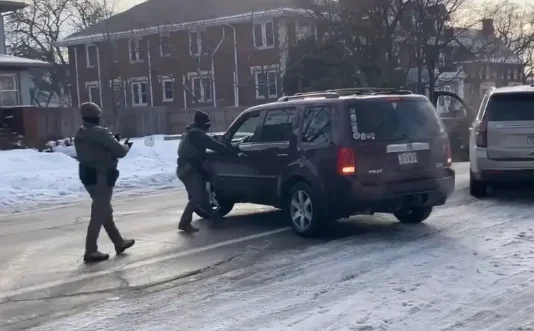
The protests were triggered by the fatal shooting of Renee Nicole Good during an ICE-related incident on Wednesday, an event that has since become the focal point of sharply conflicting narratives.
Funding Trails and Activist Infrastructure
One organization frequently cited in connection with the protests is Indivisible Twin Cities, which publicly describes itself as a volunteer-driven grassroots group. The Post reports that the organization has been instrumental in coordinating demonstrations opposing ICE activity in the region.
Financial records show that the Washington, D.C.–based Indivisible Project — the national organization linked to local chapters — received approximately $7.85 million in donations from the Open Society Foundations between 2018 and 2023. The foundation is led by George Soros and has long funded progressive political causes. Indivisible’s stated mission focuses on opposing the political agenda of former President Donald Trump.
The Indivisible network has previously been associated with large-scale demonstrations, including protests tied to Venezuela policy and the nationwide “No Kings” movement critical of the Trump administration.
Despite its visible presence, Indivisible Twin Cities does not publicly list individual leaders on its website, leaving its internal leadership structure largely opaque.
A Death, and Two Competing Narratives
Tensions escalated dramatically following the death of Renee Nicole Good. Federal authorities claim Good was shot after attempting to strike an ICE agent with her vehicle. Activist groups, however, have forcefully disputed that account.
Speaking at a protest, Jaylani Hussein, executive director of the Minnesota chapter of the Council on American-Islamic Relations (CAIR), accused federal officials of misleading the public.
“A young observer killed while observing, we believe peacefully,” Hussein said through a megaphone. “They are lying about what happened.”
While some left-leaning outlets described Good as a “legal observer” present during an ICE operation at her home, the Post reports that she was an active anti-ICE organizer who had recently moved from Colorado. She was allegedly affiliated with “ICE Watch,” a group known for monitoring and disrupting ICE activity in Minneapolis.
Prominent Figures Behind the Protests
Several well-known activists have been linked to organizing or amplifying the demonstrations.
Nekima Levy Armstrong, founder of the Racial Justice Network and a civil rights attorney, has been identified as a key organizer. Social media posts suggest she played a role in deploying legal observers to document ICE raids.
Armstrong previously gained national attention during the 2020 George Floyd protests and has recently criticized Minnesota Governor Tim Walz for stepping aside amid a welfare fraud investigation.
“When Democrats respond to bad-faith attacks by retreating, they don’t just lose candidates,” Armstrong wrote online. “They legitimize the tactic.”
Another figure connected to the protests is Edwin Torres DeSantiago, leader of the Immigrant Defense Network — a coalition representing more than 90 nonprofit and faith-based organizations.
DeSantiago, who made history as the first undocumented immigrant to earn a doctorate from the University of Minnesota, publicly accused the Trump administration of spreading fear and instability in Minneapolis following Good’s death.
Legal Scrutiny and Possible Ramifications
Beyond the protests themselves, legal experts are now examining potential criminal implications tied to the incident. Appearing on Fox & Friends, Fox News legal analyst Gregg Jarrett suggested that investigators may look beyond the individual who was killed.
Jarrett noted that Renee Good’s spouse, Rebecca Good, could face legal scrutiny depending on evidence uncovered during the investigation. He explained that charges such as aiding and abetting could apply if authorities determine she encouraged actions that interfered with law enforcement.
“The legal assessment would depend on intent and motive,” Jarrett said, raising the possibility of charges tied to assisting someone fleeing police under a domestic terrorism framework.
Conclusion
As demonstrations continue throughout Minneapolis, the conversation is shifting from street-level outrage to the organizational forces believed to be guiding it. What began as a response to a single tragic death is now being examined through a broader political, financial, and legal lens.
With disputed accounts of the shooting, prominent activist involvement, and questions surrounding funding and coordination, the unfolding situation highlights a deeper national conflict over immigration enforcement, protest movements, and the power structures that often operate behind moments of public unrest.