
Have you ever approached your parked car and felt a subtle shiver crawl up your spine as your eyes caught something unusual—a coin wedged in the handle, a tiny scratch along the door, or a mysterious object on the passenger seat?
At first glance, it might seem harmless, even trivial. But almost instantly, your mind starts spinning with questions: Was this left intentionally? Could someone have tampered with my car? That uneasy feeling isn’t just paranoia—it’s your brain responding to the unexpected. Understanding why this reaction occurs can transform anxiety into calm vigilance.

Why Odd Details Grab Our Attention
Humans are wired to notice changes in their surroundings—a trait honed over millennia as a survival mechanism. Our ancestors needed to detect subtle shifts in the environment, like a rustle in the grass or a shadow in the trees, because these often signaled predators or other threats. Today, that same neural circuitry interprets anomalies—such as a coin tucked into a car handle or a scratch that wasn’t there yesterday—as potentially important signals.
This is known as attentional bias: the brain’s tendency to prioritize stimuli that are unusual, unfamiliar, or possibly dangerous. Even minor irregularities trigger heightened focus, as the mind unconsciously assesses whether the anomaly is benign or harmful. This instinctual vigilance is why something as small as a coin or a scratch can feel disproportionately significant.
Simple Explanations for Strange Objects

While our brains often jump to worst-case scenarios, most odd discoveries have straightforward explanations. Consider these common possibilities:
Environmental Factors: Wind, rain, or falling leaves can place objects on or around a car in odd positions.
Accidental Drops: Someone walking by may have inadvertently brushed against your vehicle, leaving something behind.
Children or Pets: Curious hands or paws can move or leave items in unexpected places.
Coincidence and Timing: Objects can appear in strange places simply due to chance or human oversight.
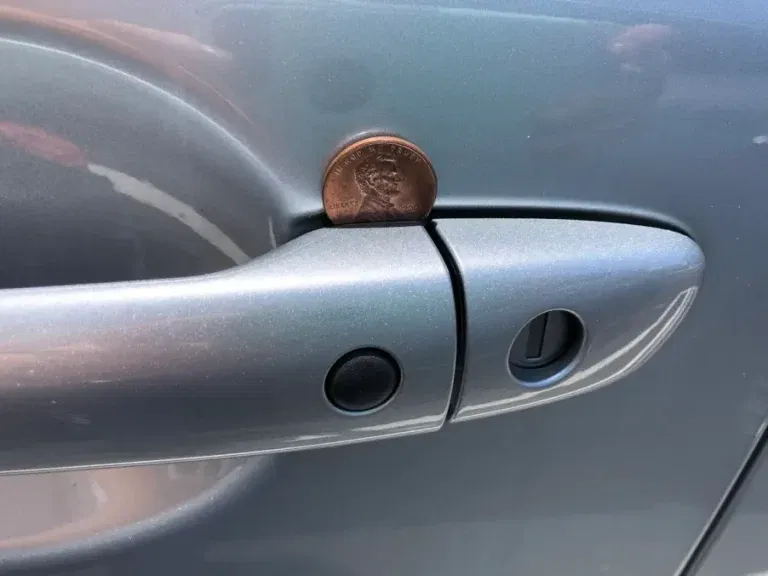
The internet is full of stories warning that coins in handles can disable locks or signal a car is being targeted. In reality, modern vehicles use sophisticated electronic systems that largely prevent such interference, making these stories largely anecdotal or outdated.
The Role of Personality and Anxiety
How you perceive these anomalies depends on both your personality and current stress levels. People with heightened vigilance or anxiety may interpret minor irregularities as potential threats, feeling a surge of alarm even when the object poses no risk. Others, naturally curious, might investigate quietly, seeking a logical explanation—sometimes discovering nothing more than a fallen leaf or a coin dropped by accident.
Both responses are rooted in the brain’s protective instincts. In evolutionary terms, it’s better to overreact to a harmless stimulus than to underreact to a genuine threat. That split-second caution could, in ancestral times, have meant the difference between life and death.
How to React Thoughtfully
Noticing something unusual doesn’t mean you should panic. Instead, treat it as a cue to remain aware and deliberate in your actions. Consider these practical steps:
Pause and Observe: Take a calm moment to assess the situation. Avoid rushing to conclusions.
Inspect Your Vehicle: Check doors, windows, and any accessible compartments to ensure everything is secure.
Document if Needed: A quick photo or note can be helpful, especially if you decide to report it later.
Trust Your Intuition—but Stay Rational: Most oddities are harmless. Your vigilance is a protective tool, not a signal of imminent danger.
Responding methodically allows you to safeguard both yourself and your peace of mind.
Conclusion
When a coin appears in your car handle or a scratch seems unfamiliar, it’s a small but revealing demonstration of how the human brain functions. Our attentional bias, curiosity, and vigilance are mechanisms designed to detect anomalies, keeping us safe even when the actual risk is minimal. Recognizing this can transform fear into thoughtful awareness.
Next time you notice something unusual on your vehicle, remember: the anomaly itself often isn’t the problem—your reaction is. By understanding the psychology behind your instincts, you can navigate moments of uncertainty with calm, measured attention, preserving both your safety and your mental composure.