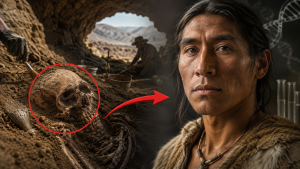
The 13,000-Year-Old Man Found On A California Island — And The Dating Test That Changed The Story Of America’s First Migration
Bones In A Canyon Wall
The canyon wall revealed them in the summer of 1959 — two human femora, the large bones of the thigh, projecting from sediment nearly 37 feet below the modern surface of Arlington Canyon on Santa Rosa Island, California.
Phil C.
Orr had not come to this particular spot looking for human remains.
The curator of anthropology and paleontology at the Santa Barbara Museum of Natural History was on Santa Rosa Island investigating the evidence for pygmy mammoths — the dwarf elephants whose fossils had turned up in the island’s ancient sediments — when erosion in the canyon wall exposed something that immediately changed the direction of his work.
Two femora.
Human.
Buried impossibly deep.
Thirty-seven feet is not the depth at which a burial becomes ancient — burial depth alone means little in archaeology.
But Orr had spent years studying the layered sediments of Santa Rosa Island and its geological history.
He recognized the stratum from which the bones protruded: water-laid sediments, deposited by ancient streams, that belonged to the terminal Pleistocene — the final chapter of the last Ice Age.
The bones, in his assessment, came from a time roughly 10,000 years before the present.
That assessment, later refined by modern methods to approximately 13,000 calendar years ago, would make the Arlington Springs individual among the oldest securely dated human remains ever found in North America.
But there was something the age alone did not immediately announce about this find.
It required a moment of geographic context to grasp.
Santa Rosa Island is not California.
It is separated from the California coastline by the Santa Barbara Channel, a body of open ocean.
In the terminal Pleistocene, the Channel Islands offered less water to cross — sea level was substantially lower than today, reducing the gap between island and mainland — but the gap remained.