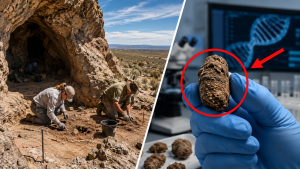
The 10,600-Year-Old Man Found In Nevada — And The DNA Discovery That Changed The Story Of The First Americans
This overlap has been one of the pieces of evidence cited by researchers who argue that the earliest Americans arrived in the hemisphere by a coastal route, moving southward along the Pacific margin before spreading inland, and that the Western Stemmed Tradition represents a coastal or near-coastal adaptation that developed independently of, and possibly earlier than, the interior Clovis tradition.
The Spirit Cave Man’s genome, as analyzed in the 2018 study, did not definitively resolve the question of whether Clovis and Western Stemmed Tradition peoples were part of the same founding population or represented distinct migration events.
The genetic data were consistent with a model in which both traditions were expressions of the same broad founding lineage, but additional ancient genomes from individuals clearly associated with each tradition will be necessary to fully address this question.
What the stone tool evidence does is situate the Spirit Cave Man within a specific technological and presumably cultural tradition — a tradition with a distinctive geographic distribution that broadly corresponds to the western portion of North America.