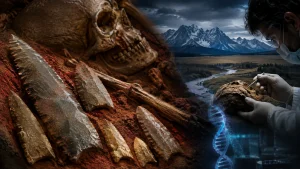
The 13,000-Year-Old Clovis Child Found With Ancient Weapons — And The Burial That Changed America’s First People Story
The Anzick child, buried in a Montana sandstone outcrop with the finest tools of a remarkable technological tradition, represents the endpoint of that extraordinary human journey.
One species, starting in Africa perhaps 300,000 years ago, gradually spreading across the entire globe, reaching every environment from the tropics to the arctic, and finally arriving in the Americas — where one small group’s story, preserved by the specific chemistry of sandstone and red ochre and cold, dry conditions, would eventually be read by scientists using technologies that would have seemed miraculous to those ancient people.
The journey from Africa to Montana took hundreds of thousands of years and covered most of the earth’s surface.
The final chapter of that journey — the crossing of Beringia, the rapid dispersal through North and South America, the founding of the populations that would eventually develop into the full diversity of Native American cultures — is the chapter that the Anzick child represents, at one of its most intimate, human moments.