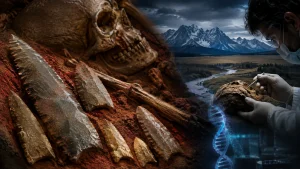
The 24,000-Year-Old Boy Buried With 120 Beads And A Mammoth-Ivory Tiara — And The DNA Test That Revealed A Hidden Source Of Native American Ancestry
The population that entered Beringia and eventually the Americas was already an admixed population — one that carried both East Asian-related ancestry and Ancient North Eurasian ancestry.
The mixing that produced this combination had happened somewhere in northeastern Asia, possibly in the region of Siberia or the broader northern Asian landmass, before the Beringian episode began.
MA-1 is not, in the researchers’ interpretation, a representative of the population that entered Beringia directly.
He is too early and too far south and west for that specific role.
He represents a related population — one of the populations that contributed ancestry to the people who eventually made the Beringian crossing, rather than one of the people who actually made it.
The analogy is imperfect, but: MA-1 represents something like the grandparents’ generation of the founding population of the Americas.