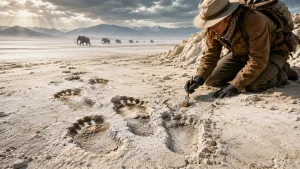
The 31,000-Year-Old Children’s Teeth Found Above The Arctic Circle — And The DNA Test That Revealed A Lost Ice Age Population Connected To Native American Origins
One of the broader lessons of the Ancient North Siberian discovery is what it says about the diversity of human populations in the Late Pleistocene — the period from roughly 50,000 to 12,000 years ago during which modern humans spread across most of the world.
Before ancient DNA research, the Pleistocene human world appeared relatively simple from a genetic standpoint.
There were modern humans in Africa, and then modern humans spread outward from Africa, and the result was the populations of modern Eurasia.
The general framework was of populations radiating outward from a single origin, gradually diversifying through isolation and adaptation, producing the major population groups that anthropologists described in the nineteenth and twentieth centuries.
Ancient DNA has revealed a different picture.