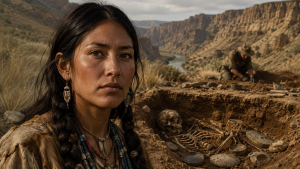
The 8,000-Year-Old Cemetery Found Beneath A Florida Pond — And The Human Brain Tissue Still Preserved Inside The Skulls
The DNA work reported in the 1986 Nature paper was conducted using the techniques available at that time.
The researchers extracted material from the preserved tissue, used restriction enzymes to cut it at specific recognition sites, and demonstrated that what they had extracted was indeed human DNA — not contamination from microorganisms or from the surrounding peat matrix.
They were able to detect and characterize fragments of mitochondrial DNA, the genetic material contained in the mitochondria rather than the cell nucleus, which is present in many more copies per cell than nuclear DNA and is therefore more likely to survive ancient conditions.
What they could not do, with 1986 technology, was anything approaching what modern ancient DNA science can accomplish.