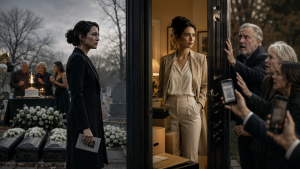
The Letter in My Purse
Chapter 1 — Mom, Don’t Cry
“Mom, don’t cry.
Let me go ask him who that woman is.”
My son, Leo, was twelve years old when he said those words to me, in the middle of a grand ballroom filled with executives and clients and employees, every one of them there to celebrate his father.
There were crystal chandeliers overhead and champagne on silver trays and an orchestra playing something soft under the murmur of a hundred important conversations, and in the center of all of it stood my husband with his hand resting on the small of another woman’s back, and my son had my hand held tight in his, and he was telling me not to cry.
I did not cry.
I want that understood from the beginning, because it matters to everything that came after.
I did not make a scene, did not raise my voice, did not throw a glass of wine or scream across the room the way a certain kind of story would have me do.
What I did was reach into my small evening purse and close my fingers around an envelope that had been prepared for me by a very good attorney, and I felt, holding it, a calm settle over me that I had not felt in years.
But to understand how a twelve-year-old boy came to be standing in a black-tie gala telling his mother not to cry, and how that envelope came to be in my purse, I have to go back four days, to an ordinary Tuesday evening in our kitchen in Evanston, Illinois, when I still believed I knew the shape of my own life.
Some part of the telling of this asks me to be fair to the woman I was that evening, and fairness requires admitting that she was not simply a victim of a clever man.
She was also someone who had chosen, for years, not to see.
The signs had been there, the coldness and the distance and the endless late meetings, and I had explained every one of them away, because the explanations let me keep the life I had, and the truth would have cost me everything.
I do not say this to blame her, that earlier self, because I understand now why she did it; the mind protects itself, and a comfortable lie can feel, from the inside, exactly like loyalty.
But I have made my peace with the fact that my blindness was, in part, a choice, and naming it honestly is the only thing that lets me be certain I will never make it again.
The woman at the stove was not stupid.
She was afraid.
And she had mistaken her fear for trust for so long that she had forgotten there was a difference.