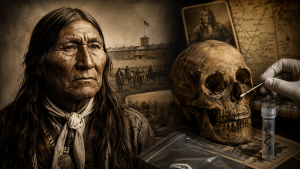
She Has Been Dead For 45,000 Years. In 2026, Three Different Scientists Gave Her Three Different Faces — And Each One Revealed Something The Others Missed
It is this combination — scientific grounding in skeletal and genomic data combined with extraordinary physical craft — that distinguishes Daynès’s work and explains why it appears in major museums worldwide.
For Zlatý kůň, the silicone reconstruction engaged all of these techniques.
The result was a face — dark-skinned, dark-eyed, dark-haired — that crossed into the territory of individual presence in a way that the other two methods, each excellent in its own way, did not fully achieve.
The Question of Ground Truth
A fundamental challenge in assessing any facial reconstruction is the absence of ground truth — of any way to verify whether the reconstructed face resembles the original.
In forensic contexts, ground truth is sometimes available: a person is eventually identified through other means (a missing persons report, a DNA database hit, a witness identification), and the reconstruction can be compared to photographs of the actual individual.